
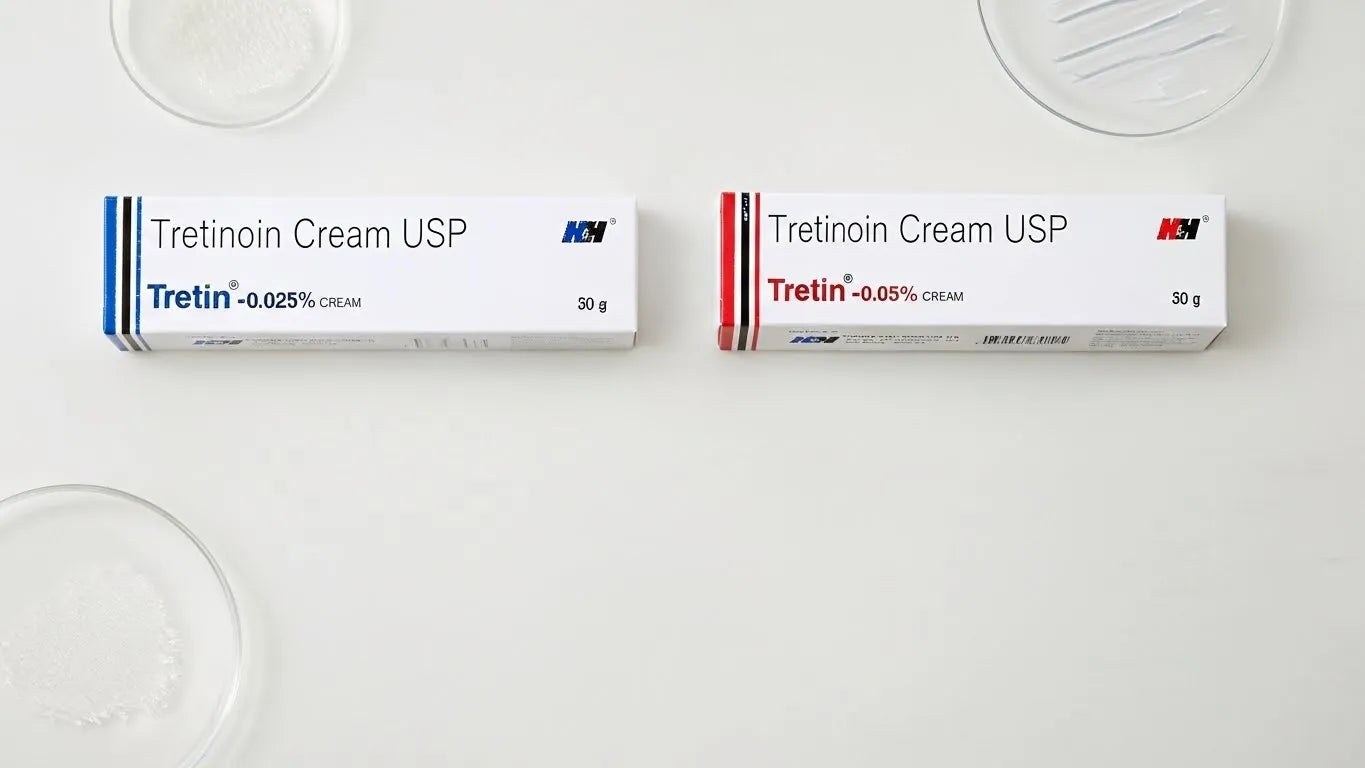
Most people treat tretinoin like a video game where you unlock higher levels to get better results, but that logic is flawed. You think that if 0.025% isn’t fixing your acne or erasing your wrinkles fast enough, you just need to jump to 0.05% or 0.1% to „level up.”
This mindset is how you end up with a compromised skin barrier, chronic redness, and a face that peels like a sunburned lizard. Tretinoin isn’t a linear progression of strength; it’s a biological disruptor. When you increase the concentration, you aren’t just adding more „power”—you’re changing the way your skin reacts to the formula entirely.
If you want a direct answer: 0.025% is for building tolerance and managing mild concerns, while 0.05% is a significant jump that often introduces much more dryness and irritation. There is no „correct” strength, only the strength your skin can actually handle without falling apart.
The Myth of the Strength Ladder
The biggest mistake you can make is assuming that moving from 0.025% to 0.05% is a simple step up in efficacy. It isn’t. Moving from 0.025% to 0.05% or 0.1% increases the amount of tretinoin in the formula, but it also fundamentally alters the physical experience of using the product. You aren’t just getting a „stronger” dose; you’re inviting a new level of inflammation into your nightly routine.
I see patients and friends make this error constantly. They use 0.025% for two months, see minimal change in their fine lines, and immediately grab a tube of 0.05% because they think they „failed” at the lower dose. They didn’t fail. Their skin simply hasn’t finished the cellular turnover process required to see the visual results of the first concentration.
It’s a trap. Higher concentrations can lead to significantly more dryness, redness, or peeling. This isn’t because the product is „better,” but because you are forcing your skin into a state of rapid cell turnover that your moisture barrier might not be ready to support. If your skin is already stinging when you apply a basic moisturizer, do not, under any circumstances, reach for a higher percentage.
And you need to understand that „more” is not always „better.” Stronger tretinoin isn’t automatically the right choice if your goal is long-term skin health rather than a quick, inflammatory fix. You want consistency, not a cycle of purging and repairing.
Deciphering the 0.025% vs 0.05% Divide
When you look at the actual chemistry, the difference between these two concentrations is about managing the threshold of irritation. Tretinoin is a retinoid that promotes skin cell turnover, unclogs pores, and reduces inflammation. It’s a heavy hitter. It works by telling your skin cells to regenerate faster than usual.
The 0.025% concentration is often the gold standard for those starting out or those with sensitive skin types. It provides a gentle nudge to the skin’s natural processes. It’s enough to begin addressing acne and fine lines without the „retinoid ugliness” phase being so severe that you can’t leave the house. It’s a slow burn. It requires patience.
The 0.05% concentration is where things get serious. For many, this is the „sweet spot” for treating moderate acne or more stubborn wrinkles. However, the jump in irritation can be non-linear. You might find that 0.025% felt like nothing, but 0.05% feels like you’ve applied acid to your face. This is because you are crossing a physiological threshold in how your skin accommodates the molecule.
Consider these differences in how they typically manifest in a real-world routine:
- 0.025% Tretinoin: Ideal for beginners, those with dry/sensitive skin, or maintenance phases. Focuses on slow, steady turnover.
- 0.05% Tretinoin: Target for active acne or more pronounced fine lines. Higher risk of the „peeling phase.”
- 0.1% Tretinoin: Very high potency. Usually reserved for severe acne or advanced photoaging, and even then, only with extreme caution.
If you are currently shopping around, you might find yourself looking for a specific brand or a tretinoin pharmacy to fulfill your prescription. Don’t just pick the highest number available. Pick the one that allows you to apply it every single night without looking like a flaky mess.
Ingredient Complexity and Formulations
Not all tretinoin creams are created equal. You can’t just look at the percentage and assume the experience will be identical across different brands. The „vehicle”—the cream, gel, or lotion that carries the tretinoin, is just as important as the active ingredient itself. A cream base will be much more forgiving for dry skin than a gel base, regardless of whether you are using 0.025% or 0.05%.
Take, for example, the Obagi line. The Obagi Tretinoin Cream 0.025%, 0.05% and 0.1% is a classic example of a highly studied formulation. In some analyses, it has been rated as „Excellent” because of its specific ingredient profile. It’s designed to be a moisturizer as much as a treatment, which is a smart move when you’re dealing with a molecule that inherently causes dryness.
When you examine the ingredients, you’ll notice that the higher-end formulations often include emollients to offset the irritation. This is why a 0.05% cream from a high-quality brand might actually feel more comfortable than a 0.025% cream from a cheap, basic manufacturer. You aren’t just paying for the tretinoin; you are paying for the delivery system that prevents your skin from turning into a desert.
The following table compares the typical user experience based on formulation style:
| Formulation Type | Best For | Typical Side Effects | Ease of Use |
|---|---|---|---|
| Gel | Oily/Acne-Prone Skin | High dryness, potential stinging | Difficult for dry skin |
| Cream | Normal/Combination Skin | Moderate dryness, peeling | Very high |
| Lotion/Emulsion | Dry/Sensitive Skin | Low irritation, minimal peeling | Highest for beginners |
If you have dry skin, a 0.05% gel is a recipe for disaster. You will spend the first month of your treatment applying heavy occlusives just to keep your skin from cracking. Match the vehicle to your skin type before you even look at the percentage.
Navigating the Purge and the Barrier
You need to prepare for the „purge.” This isn’t a myth. Because tretinoin speeds up cell turnover, it pushes everything that was already brewing under your skin, clogged pores, microcomedones, and inflammation, to the surface all at once. If you are using 0.05% to treat acne, you might see an initial breakout that looks worse than when you started.
The mistake most people make during this phase is panicking. They think, „This 0.05% is killing my skin,” and they stop using it. Or worse, they try to „dry out” the acne with benzoyl peroxide, which is like throwing gasoline on a fire. You are dealing with a chemical exfoliation and a biological purge at the same time. It is a lot for your skin to handle.
But there is a limit. There is a difference between „the purge” and „a damaged barrier.” If your skin is red, itchy, stinging when you use a gentle cleanser, or feels tight and shiny like plastic, you have damaged your barrier. This is not part of the process. This is a sign that you have gone too fast or used a concentration that is too high for your current skin state.
To avoid this, follow the „sandwich method.” Apply a thin layer of moisturizer, then your tretinoin, then another layer of moisturizer. This slows down the penetration of the drug just enough to mitigate the irritation without negating the benefits. It’s a tactic used by seasoned skincare enthusiasts to bridge the gap between 0.025% and 0.05% without the side effects being debilitating.
Patience is your only real ally here. Tretinoin is a marathon, not a sprint. If you rush the process by jumping concentrations too early, you’ll spend more time repairing your skin than actually improving it.
Stop applying tretinoin to damp skin.
Common questions
How long does tretinoin 0.025% take to work for wrinkles?
It typically takes 3 to 6 months of consistent use to see visible improvements in fine lines and wrinkles.
Is tretinoin 0.05% too strong?
It is not too strong if your skin is acclimated, but it is more potent than 0.025% and carries a higher risk of irritation.
What is the downside of tretinoin?
Common side effects include skin dryness, peeling, redness, and increased sun sensitivity.
Can I use 0.05% tretinoin every day?
Yes, once your skin has built up tolerance, though many users find using it every other night is sufficient to minimize irritation.
Which is better: tretinoin 0.025% or 0.05%?
Beginners should start with 0.025% to minimize side effects, while those with resilient skin may prefer 0.05% for faster results.
Legutóbbi hozzászólások